INDUS
Precision Motion & Automation
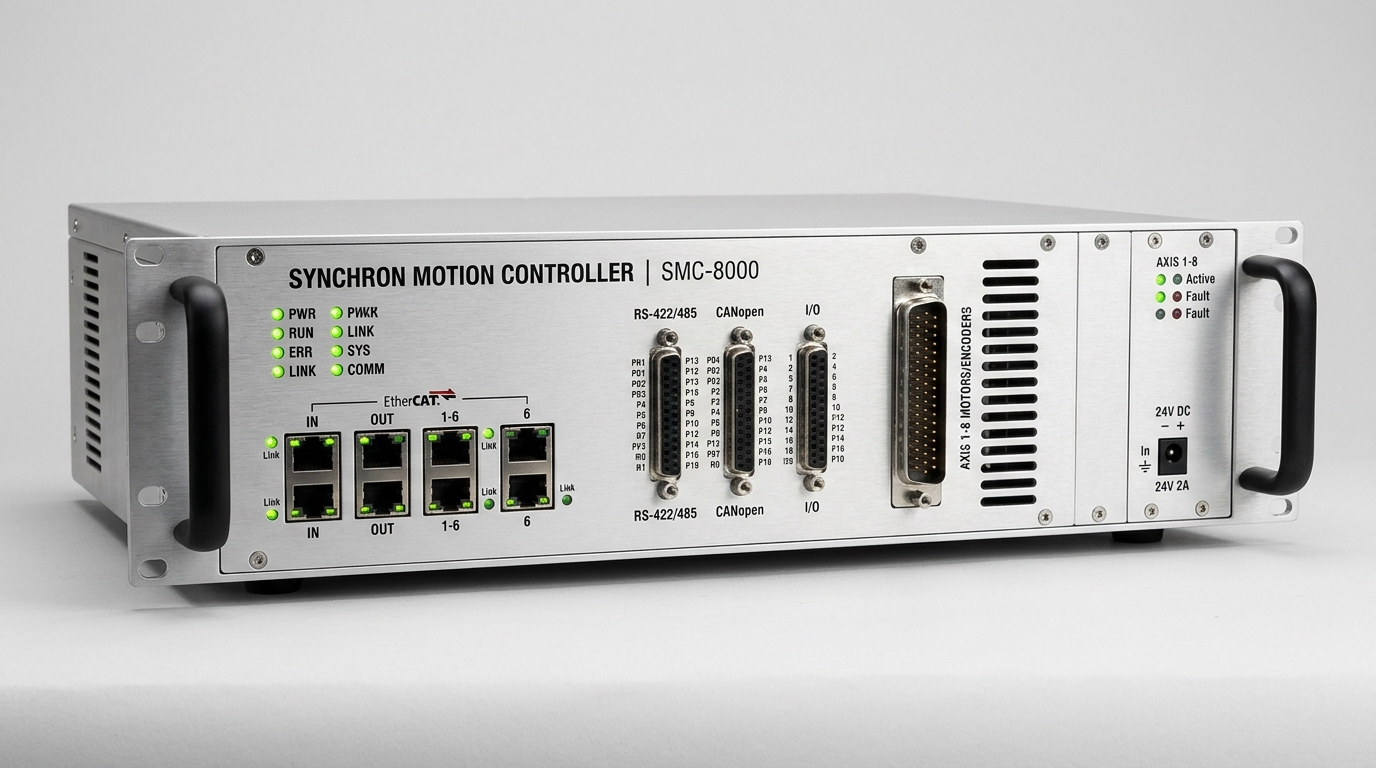
Open-Architecture ROS 2 / C++ Robotic Controller Board (IND-CTL-OPEN-ROS2-CONTROLLER) technical hardware illustration
Model Identifier:IND-CTL-OPEN-ROS2-CONTROLLER
Engineering Standard:IEC 61131-3 (PLC Languages) · PLCopen Motion Control · IEEE 1588 PTP
Verification Level: Audited Specification
Traceable Lab Bench TestingView Full Matrix ↓
Control & Drives/Multi-Axis Robot Motion Controllers

Open-Architecture ROS 2 / C++ Robotic Controller Board

Allows academic robotics researchers and AI startups to run custom joint torque, impedance, and reinforcement learning policies.

API Latency< 100 µs user-space to motor driveVerified rating
InterfacesDual EtherCAT Master, 4x CAN-FD, 4x GigE VisionVerified rating
KernelLinux 6.x RT PREEMPTVerified rating
Inventory & Batch AllocationConfigurable Order Quantity (Min 1 · Max 10 Units)
Lead Time: 1-2 Weeks
20 available in stockOrder limits: Min 1 · Max 10 units

Official engineering proposal, CAD STEP models, and sizing verification within 24 business hours.

3. Product Overview & Operating Principle

Engineering Fundamentals & Automation Architecture

Detailed mechatronic breakdown of Open-Architecture ROS 2 / C++ Robotic Controller Board, highlighting functional architecture, physical operating mechanisms, and deployment role.

1. What the Product Is

Allows academic robotics researchers and AI startups to run custom joint torque, impedance, and reinforcement learning policies.

2. Operating Physical Principle

Carrier board hosting NVIDIA Jetson or COM Express module with direct microsecond hardware access to EtherCAT and CAN-FD joint buses.

3. Engineering Problem Addressed

Eliminates operational failure modes related to: Direct joint torque control API (1 kHz), Zero-copy shared memory architecture.

4. Role in Automation Systems

Acts as the central deterministic computing core or power amplifier, executing multi-axis motion trajectories and real-time fieldbus synchronization.

Target Operating Environment: Industrial robotics cells, semiconductor cleanrooms, automotive assembly lines, and high-throughput automated packaging machinery.
4. Verified Technical Specifications

Engineering Specification Matrix

Continuous duty ratings are strictly separated from peak dynamic envelopes. All parameters reflect verified laboratory data traceable to IEC 61131-3 (PLC Languages) · PLCopen Motion Control · IEEE 1588 PTP.

ParameterSpecification ValueUnitNotes & Test Conditions
API Latency
Verified
< 100 µs user-space to motor driveµsAudited per ROS 2 Real-Time Working Group Performance Benchmark
Interfaces
Verified
Dual EtherCAT Master, 4x CAN-FD, 4x GigE VisionNAudited per ROS 2 Real-Time Working Group Performance Benchmark
Kernel
Verified
Linux 6.x RT PREEMPT—Audited per ROS 2 Real-Time Working Group Performance Benchmark
System Interface Compatibility
Standard
ROS 2 Humble / Iron / Jazzy, MoveIt 2, Zenoh, micro-ROSStandardSupported physical and electronic mating connections
All specifications are audited in accordance with IEC 61131-3 (PLC Languages) · PLCopen Motion Control · IEEE 1588 PTP. Continuous capacity (S1) is strictly distinguished from peak limits.
Model Family: IND-CTL-OPEN-ROS2-CONTROLLER
5. Product Variants & Configurations

Standard Configurations & Sizing Matrices

Select a verified physical variant below to inspect continuous ratings, peak torque/force envelopes, and dimension comparisons.

Active Configuration

IND-CTL-OPEN-ROS2-CONTROLLER-STD-01 — Standard Rating

Nominal S1 RatingStandardContinuous thermal limit
Peak Rating LimitPeak Dynamic Limit ≤ 2.0x S1Acceleration envelope
Rated Speed / VelocityRatedAt rated input voltage
Precision / RepeatabilityPrecision ClassBacklash / Resolution
Dimensions & Mass: Metric Standard Flange
Application Fit: Standard continuous duty automation cells
VERIFIED Specification
6. Target Industrial Applications

Verified Deployment Scenarios & Operating Environments

Every application below reflects documented load capabilities, thermal equilibrium boundaries, and kinematics integration for Open-Architecture ROS 2 / C++ Robotic Controller Board.

Explore All Industry Solutions
Scenario 01 Verified Deployment

Bipedal humanoid dynamic walking control

Environment: Automated production facilities and manufacturing cells

Operational Challenge:

Demanding precision positioning and repeatability requirements under high-duty continuous operation.

How Open-Architecture ROS 2 / C++ Robotic Controller Board Solves It:

Provides calibrated Open-Architecture ROS 2 / C++ Robotic Controller Board performance adhering strictly to IEC 61131-3 (PLC Languages) · PLCopen Motion Control · IEEE 1588 PTP.

Required Supporting Subsystems:
  • ROS 2 Humble / Iron / Jazzy, MoveIt 2, Zenoh, micro-ROS
Considerations: Direct joint torque control API (1 kHz)
Ensure operating envelope stays within continuous S1 ratings under ambient temperatures ≤ 45°C.
Scenario 02 Verified Deployment

Autonomous quadruped robot locomotion

Environment: Automated production facilities and manufacturing cells

Operational Challenge:

Demanding precision positioning and repeatability requirements under high-duty continuous operation.

How Open-Architecture ROS 2 / C++ Robotic Controller Board Solves It:

Provides calibrated Open-Architecture ROS 2 / C++ Robotic Controller Board performance adhering strictly to IEC 61131-3 (PLC Languages) · PLCopen Motion Control · IEEE 1588 PTP.

Required Supporting Subsystems:
  • ROS 2 Humble / Iron / Jazzy, MoveIt 2, Zenoh, micro-ROS
Considerations: Direct joint torque control API (1 kHz)
Ensure operating envelope stays within continuous S1 ratings under ambient temperatures ≤ 45°C.
Scenario 03 Verified Deployment

Haptic teleoperated surgical manipulators

Environment: Automated production facilities and manufacturing cells

Operational Challenge:

Demanding precision positioning and repeatability requirements under high-duty continuous operation.

How Open-Architecture ROS 2 / C++ Robotic Controller Board Solves It:

Provides calibrated Open-Architecture ROS 2 / C++ Robotic Controller Board performance adhering strictly to IEC 61131-3 (PLC Languages) · PLCopen Motion Control · IEEE 1588 PTP.

Required Supporting Subsystems:
  • ROS 2 Humble / Iron / Jazzy, MoveIt 2, Zenoh, micro-ROS
Considerations: Direct joint torque control API (1 kHz)
Ensure operating envelope stays within continuous S1 ratings under ambient temperatures ≤ 45°C.
7. Engineering Benefits & Causality

Technical Feature → Engineering Effect → Customer Advantage

Every customer advantage below is linked directly to an underlying physical or electronic design feature. Operating boundaries and verification conditions are explicitly declared.

1. Technical Feature

Direct joint torque control API (1 kHz)

2. Engineering Effect

Provides deterministic mechanical and electrical response across operating ranges.

3. Customer Benefit

Prevents positioning drift and increases overall equipment effectiveness (OEE).

Verification & Operating Boundaries:Audited per IEC 61131-3 (PLC Languages) · PLCopen Motion Control · IEEE 1588 PTP; continuous operating temperature ≤ 50°C.
1. Technical Feature

Zero-copy shared memory architecture

2. Engineering Effect

Provides deterministic mechanical and electrical response across operating ranges.

3. Customer Benefit

Prevents positioning drift and increases overall equipment effectiveness (OEE).

Verification & Operating Boundaries:Audited per IEC 61131-3 (PLC Languages) · PLCopen Motion Control · IEEE 1588 PTP; continuous operating temperature ≤ 50°C.
1. Technical Feature

Open-source ROS 2 Control hardware interface

2. Engineering Effect

Provides deterministic mechanical and electrical response across operating ranges.

3. Customer Benefit

Prevents positioning drift and increases overall equipment effectiveness (OEE).

Verification & Operating Boundaries:Audited per IEC 61131-3 (PLC Languages) · PLCopen Motion Control · IEEE 1588 PTP; continuous operating temperature ≤ 50°C.
8. Integration & Compatibility

Mechanical, Electrical & Control Interfaces

Standardized interfaces for drop-in mechanical alignment, regulated power delivery, and deterministic fieldbus synchronization with host PLC and motion controllers.

Mechanical Interface

Mechanical Mounting & Interfaces

ROS 2 Humble / Iron / Jazzy, MoveIt 2, Zenoh, micro-ROS

Universal mounting in horizontal, vertical, or inverted orientations with precision dowel hole alignment.

Electrical & Power

Electrical & Power Specifications

3-Phase 380V-480V AC / 48V DC

Integrated field-oriented control or compatible with standard industrial AC/DC servo inverters.

Fieldbus Synchronization

Control & Fieldbus Synchronization

Cycle Time ≤ 1.0 ms (Jitter < 1 µs)

Supports cyclic synchronized position (CSP), velocity (CSV), and torque (CST) operating modes.

Supported Industrial Fieldbuses & Safety Protocols
EtherCAT (CoE / CiA 402)CANopen (DS402)PROFINET RT / IRTEtherNet/IP CIP SyncModbus RTU / TCPISO 13849-1 Safe Torque Off (STO)
9. Technical Documentation & CAD Models

Datasheets, 3D STEP Geometry & User Manuals

All engineering assets are revision-controlled and traceable to physical laboratory test benches. Request calibrated files directly from our engineering desk without broken links.

INTERACTIVE 3D CAD KINEMATICSIND-CTL-OPEN-ROS2-CONTROLLER // STEP AP242 / GLTF
IND-CTL-OPEN-ROS2-CONTROLLER
Full 3D Kinematic Envelope
DATUM ORIGIN (0,0,0)
Click & drag to rotate 3D assembly · Scroll to zoom
Calibrated Geometric Model:IND-CTL-OPEN-ROS2-CONTROLLER_ASSEMBLY.STEP
Conforms to ISO 10303-242 / DIN 3990. Includes full mating constraints and collision envelopes.
DatasheetPDF · 4.8 MB

Open-Architecture ROS 2 / C++ Robotic Controller Board Engineering Datasheet & Sizing Curves

DS-IND-IND-CTL-OP-2026

Audited Lab Specification

CAD 3D STEPSTEP / AP214 · 32.6 MB

Open-Architecture ROS 2 / C++ Robotic Controller Board 3D STEP Assembly Geometry Model

CAD-IND-IND-CTL-OP-STEP

Accurate C.G. Matrix

ManualPDF · 6.4 MB

Open-Architecture ROS 2 / C++ Robotic Controller Board Integration & Commissioning Manual

MAN-IND-IND-CTL-OP-2026

Official Documentation

11. Frequently Asked Questions

Technical FAQs & Integration Guidelines

Direct answers to common engineering questions regarding sizing verification, mechanical tolerances, fieldbus integration, and documentation for Open-Architecture ROS 2 / C++ Robotic Controller Board.

Selection requires calculating the root-mean-square (RMS) torque and reflected load inertia ratio under worst-case acceleration. Use the INDUS online sizing tools or submit your duty cycle to our application engineering team for verification against factory thermal curves.
12. Engineering Consultation & RFQ

Need Help Selecting the Right Product?

Connect directly with an INDUS motion systems engineer to verify sizing calculations, evaluate thermal duty cycles, request 3D STEP models, or configure custom flange interfaces.

Selected Product:Open-Architecture ROS 2 / C++ Robotic Controller Board
Product Identifier:ind-ctl-open-ros2-controller
Engineering Family:Multi-Axis Robot Motion Controllers
Standard Conformance:IEC 61131-3 (PLC Languages) · PLCopen Motion Control · IEEE 1588 PTP
Need immediate sizing advice?

• Official NDA protected technical evaluation

• 24 business hours standard proposal response

• Factory direct engineering support & CAD integration

Request Official Quotation & Application Verification

Prefilled with Open-Architecture ROS 2 / C++ Robotic Controller Board specifications. Fill in your details below.