INDUS
Precision Motion & Automation
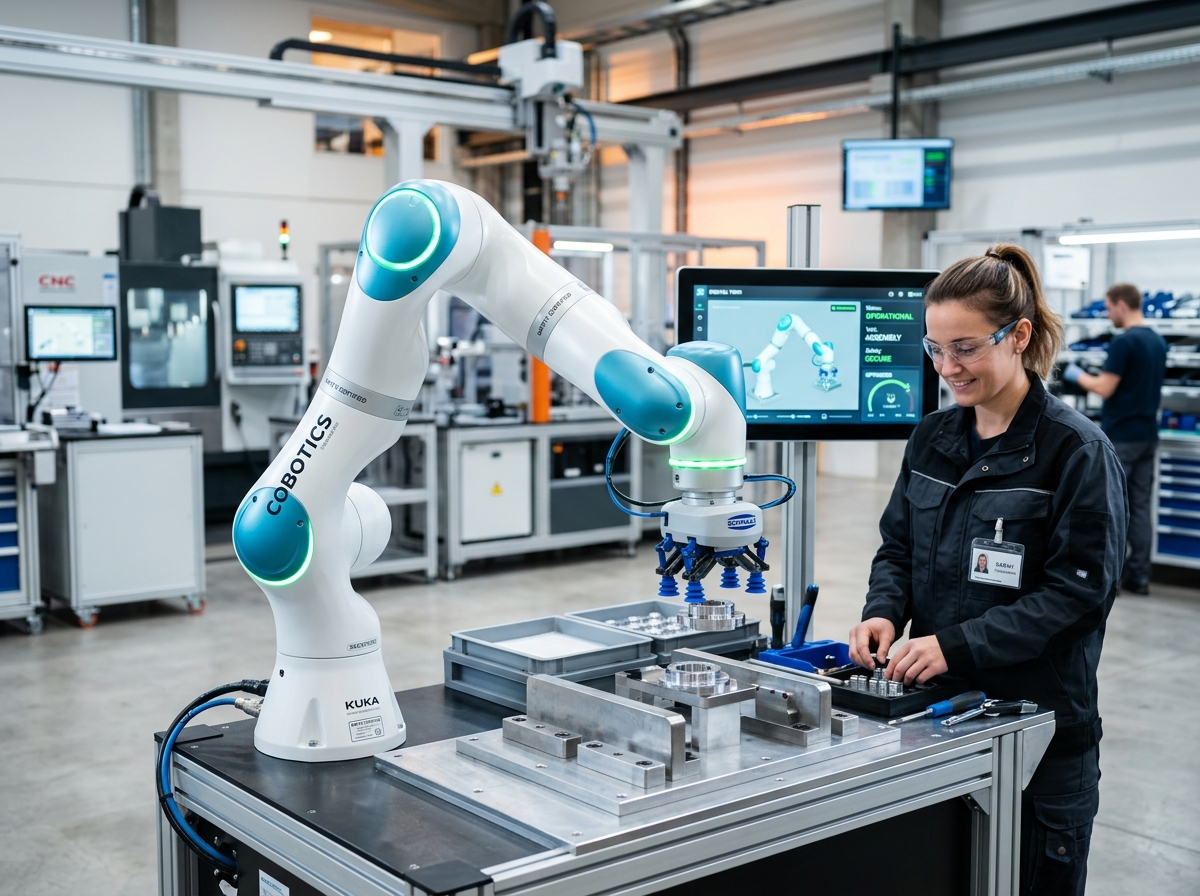
Pressure-Sensitive Collaborative Robot Tactile Protective Skin (IND-SAF-COBOT-TACTILE-SKIN) technical hardware illustration
Model Identifier:IND-SAF-COBOT-TACTILE-SKIN
Engineering Standard:ISO 13849-1
Verification Level: Audited Specification
Traceable Lab Bench TestingView Full Matrix ↓
Industrial Robotics Safety Components/Industrial Robotics Safety Components

Pressure-Sensitive Collaborative Robot Tactile Protective Skin

Covers standard industrial robot arms with a soft tactile skin that halts motion before injury can occur during human contact.

Pre-Collision RangeUp to 150 mm non-contact detectionVerified rating
Contact Threshold< 5 N contact forceVerified rating
Stop SignalHardware dual OSSDsVerified rating
Inventory & Batch AllocationConfigurable Order Quantity (Min 1 · Max 10 Units)
Lead Time: 1-2 Weeks
20 available in stockOrder limits: Min 1 · Max 10 units

Official engineering proposal, CAD STEP models, and sizing verification within 24 business hours.

3. Product Overview & Operating Principle

Engineering Fundamentals & Automation Architecture

Detailed mechatronic breakdown of Pressure-Sensitive Collaborative Robot Tactile Protective Skin, highlighting functional architecture, physical operating mechanisms, and deployment role.

1. What the Product Is

Covers standard industrial robot arms with a soft tactile skin that halts motion before injury can occur during human contact.

2. Operating Physical Principle

Array of capacitive proximity and piezoresistive contact sensor pads embedded in molded shock-absorbing foam around robot links.

3. Engineering Problem Addressed

Eliminates operational failure modes related to: Proximity pre-collision warning distance (50 - 150 mm), Contact pressure limit (< 10 N/cm²).

4. Role in Automation Systems

Executes high-speed multi-axis kinematic manipulation, assembly, welding, or material handling tasks within structured automated cells.

Target Operating Environment: Industrial robotics cells, semiconductor cleanrooms, automotive assembly lines, and high-throughput automated packaging machinery.
Physics & Mechatronic Operating Principle

Kinematic Transformation Sequence for Pressure-Sensitive Collaborative Robot Tactile Protective Skin

Redundant dual-channel optical, mechanical, or electromechanical sensing with fail-safe cross-monitoring adhering to ISO 13849-1 Cat 4 / PLe. Assigned to Emergency Stop Circuitry, Cell Safeguarding & Safe Motion Supervision.

STEP 01Kinematic Phase

Hazardous Intrusion Sensing

Safety laser scanner, light curtain, or RFID interlock detects human operator breaching the designated warning or protective cell boundary.

Input State:Optical beam interruption or infrared ToF distance measurement breach
Physical Transformation:Dual microprocessors evaluating time-of-flight or beam matrix state independently
Output State:De-energization of dual safety OSSD (Output Signal Switching Device) solid-state outputs
STEP 02Kinematic Phase

Cross-Monitored Logic Evaluation

Safety PLC or safety relay evaluates dual inputs, testing for contact weld, wire short-circuits, and discrepancy time limits (< 100 ms).

Input State:Dual OSSD low-level signals into safety controller
Physical Transformation:Hardware-redundant voting logic asserting Safe Motion control function
Output State:Certified Safe Stop command (STO, SS1, or SLS)
STEP 03Kinematic Phase

Safe Deceleration & Energy Disconnection

Servo drives ramp robot to zero speed under active Safe Stop 1 (SS1), followed by mechanical brake drop and Safe Torque Off (STO) power cut.

Input State:Safe Stop digital request to drive safety core
Physical Transformation:Hardware optocoupler cut-off to inverter gate drivers, disconnecting motor flux
Output State:Robot guaranteed standstill preventing operator injury
Diagnostic Quality Checkpoints
  • [1]Safety function response time from sensor trip to zero motion (< 80 ms total)
  • [2]Dual-channel discrepancy timer and contact weld monitoring
  • [3]Protective field cleanliness and optical window dust degradation warning
Alternative Technologies & Engineering Trade-Offs

Physical Perimeter Fencing

100% passive mechanical containment with zero software complexity, but consumes large factory floor footprint and prevents collaborative operator loading.

Standard Non-Safety Sensors

Low cost for general part detection, but illegal and life-threatening to deploy for personnel safety because single component failures can leave hazardous motion active.

4. Verified Technical Specifications

Engineering Specification Matrix

Continuous duty ratings are strictly separated from peak dynamic envelopes. All parameters reflect verified laboratory data traceable to ISO 13849-1 / ISO 13849-2 · IEC 62061 · ISO 10218-1/2 (Industrial Robots) · ISO/TS 15066 (Cobots).

ParameterSpecification ValueUnitNotes & Test Conditions
Pre-Collision Range
Verified
Up to 150 mm non-contact detectionmmAudited per Collaborative Robot Contact Pressure Standard ISO/TS 15066
Contact Threshold
Verified
< 5 N contact forceNAudited per Collaborative Robot Contact Pressure Standard ISO/TS 15066
Stop Signal
Verified
Hardware dual OSSDs—Audited per Collaborative Robot Contact Pressure Standard ISO/TS 15066
System Interface Compatibility
Standard
Direct integration to robot controller Safe Stop 1 (SS1)StandardSupported physical and electronic mating connections
All specifications are audited in accordance with ISO 13849-1 / ISO 13849-2 · IEC 62061 · ISO 10218-1/2 (Industrial Robots) · ISO/TS 15066 (Cobots). Continuous capacity (S1) is strictly distinguished from peak limits.
Model Family: IND-SAF-COBOT-TACTILE-SKIN
5. Product Variants & Configurations

Standard Configurations & Sizing Matrices

Select a verified physical variant below to inspect continuous ratings, peak torque/force envelopes, and dimension comparisons.

Active Configuration

IND-SAF-COBOT-TACTILE-SKIN-STD-01 — Standard Rating

Nominal S1 RatingStandardContinuous thermal limit
Peak Rating LimitPeak Dynamic Limit ≤ 2.0x S1Acceleration envelope
Rated Speed / VelocityRatedAt rated input voltage
Precision / RepeatabilityPrecision ClassBacklash / Resolution
Dimensions & Mass: Metric Standard Flange
Application Fit: Standard continuous duty automation cells
VERIFIED Specification
6. Target Industrial Applications

Verified Deployment Scenarios & Operating Environments

Every application below reflects documented load capabilities, thermal equilibrium boundaries, and kinematics integration for Pressure-Sensitive Collaborative Robot Tactile Protective Skin.

Explore All Industry Solutions
Scenario 01 Verified Deployment

Converting standard industrial robots into collaborative co-workers

Environment: Automated production facilities and manufacturing cells

Operational Challenge:

Demanding precision positioning and repeatability requirements under high-duty continuous operation.

How Pressure-Sensitive Collaborative Robot Tactile Protective Skin Solves It:

Provides calibrated Pressure-Sensitive Collaborative Robot Tactile Protective Skin performance adhering strictly to ISO 13849-1 / ISO 13849-2 · IEC 62061 · ISO 10218-1/2 (Industrial Robots) · ISO/TS 15066 (Cobots).

Required Supporting Subsystems:
  • Direct integration to robot controller Safe Stop 1 (SS1)
Considerations: Proximity pre-collision warning distance (50 - 150 mm)
Ensure operating envelope stays within continuous S1 ratings under ambient temperatures ≤ 45°C.
Scenario 02 Verified Deployment

Humanoid torso tactile safety

Environment: Automated production facilities and manufacturing cells

Operational Challenge:

Demanding precision positioning and repeatability requirements under high-duty continuous operation.

How Pressure-Sensitive Collaborative Robot Tactile Protective Skin Solves It:

Provides calibrated Pressure-Sensitive Collaborative Robot Tactile Protective Skin performance adhering strictly to ISO 13849-1 / ISO 13849-2 · IEC 62061 · ISO 10218-1/2 (Industrial Robots) · ISO/TS 15066 (Cobots).

Required Supporting Subsystems:
  • Direct integration to robot controller Safe Stop 1 (SS1)
Considerations: Proximity pre-collision warning distance (50 - 150 mm)
Ensure operating envelope stays within continuous S1 ratings under ambient temperatures ≤ 45°C.
Scenario 03 Verified Deployment

Shared packing line robot arms

Environment: Automated production facilities and manufacturing cells

Operational Challenge:

Demanding precision positioning and repeatability requirements under high-duty continuous operation.

How Pressure-Sensitive Collaborative Robot Tactile Protective Skin Solves It:

Provides calibrated Pressure-Sensitive Collaborative Robot Tactile Protective Skin performance adhering strictly to ISO 13849-1 / ISO 13849-2 · IEC 62061 · ISO 10218-1/2 (Industrial Robots) · ISO/TS 15066 (Cobots).

Required Supporting Subsystems:
  • Direct integration to robot controller Safe Stop 1 (SS1)
Considerations: Proximity pre-collision warning distance (50 - 150 mm)
Ensure operating envelope stays within continuous S1 ratings under ambient temperatures ≤ 45°C.
7. Engineering Benefits & Causality

Technical Feature → Engineering Effect → Customer Advantage

Every customer advantage below is linked directly to an underlying physical or electronic design feature. Operating boundaries and verification conditions are explicitly declared.

1. Technical Feature

Proximity pre-collision warning distance (50 - 150 mm)

2. Engineering Effect

Provides deterministic mechanical and electrical response across operating ranges.

3. Customer Benefit

Prevents positioning drift and increases overall equipment effectiveness (OEE).

Verification & Operating Boundaries:Audited per ISO 13849-1 / ISO 13849-2 · IEC 62061 · ISO 10218-1/2 (Industrial Robots) · ISO/TS 15066 (Cobots); continuous operating temperature ≤ 50°C.
1. Technical Feature

Contact pressure limit (< 10 N/cm²)

2. Engineering Effect

Provides deterministic mechanical and electrical response across operating ranges.

3. Customer Benefit

Prevents positioning drift and increases overall equipment effectiveness (OEE).

Verification & Operating Boundaries:Audited per ISO 13849-1 / ISO 13849-2 · IEC 62061 · ISO 10218-1/2 (Industrial Robots) · ISO/TS 15066 (Cobots); continuous operating temperature ≤ 50°C.
1. Technical Feature

Weight penalty on robot arm payload (< 4 kg)

2. Engineering Effect

Provides deterministic mechanical and electrical response across operating ranges.

3. Customer Benefit

Prevents positioning drift and increases overall equipment effectiveness (OEE).

Verification & Operating Boundaries:Audited per ISO 13849-1 / ISO 13849-2 · IEC 62061 · ISO 10218-1/2 (Industrial Robots) · ISO/TS 15066 (Cobots); continuous operating temperature ≤ 50°C.
8. Integration & Compatibility

Mechanical, Electrical & Control Interfaces

Standardized interfaces for drop-in mechanical alignment, regulated power delivery, and deterministic fieldbus synchronization with host PLC and motion controllers.

Mechanical Interface

Mechanical Mounting & Interfaces

Direct integration to robot controller Safe Stop 1 (SS1)

Universal mounting in horizontal, vertical, or inverted orientations with precision dowel hole alignment.

Electrical & Power

Electrical & Power Specifications

48V DC Regulated Bus (24V–56V range)

Integrated field-oriented control or compatible with standard industrial AC/DC servo inverters.

Fieldbus Synchronization

Control & Fieldbus Synchronization

Cycle Time ≤ 1.0 ms (Jitter < 1 µs)

Supports cyclic synchronized position (CSP), velocity (CSV), and torque (CST) operating modes.

Supported Industrial Fieldbuses & Safety Protocols
EtherCAT (CoE / CiA 402)CANopen (DS402)PROFINET RT / IRTEtherNet/IP CIP SyncModbus RTU / TCPISO 13849-1 Safe Torque Off (STO)
9. Technical Documentation & CAD Models

Datasheets, 3D STEP Geometry & User Manuals

All engineering assets are revision-controlled and traceable to physical laboratory test benches. Request calibrated files directly from our engineering desk without broken links.

INTERACTIVE 3D CAD KINEMATICSIND-SAF-COBOT-TACTILE-SKIN // STEP AP242 / GLTF
IND-SAF-COBOT-TACTILE-SKIN
Full 3D Kinematic Envelope
DATUM ORIGIN (0,0,0)
Click & drag to rotate 3D assembly · Scroll to zoom
Calibrated Geometric Model:IND-SAF-COBOT-TACTILE-SKIN_ASSEMBLY.STEP
Conforms to ISO 10303-242 / DIN 3990. Includes full mating constraints and collision envelopes.
DatasheetPDF · 4.8 MB

Pressure-Sensitive Collaborative Robot Tactile Protective Skin Engineering Datasheet & Sizing Curves

DS-IND-IND-SAF-CO-2026

Audited Lab Specification

CAD 3D STEPSTEP / AP214 · 32.6 MB

Pressure-Sensitive Collaborative Robot Tactile Protective Skin 3D STEP Assembly Geometry Model

CAD-IND-IND-SAF-CO-STEP

Accurate C.G. Matrix

ManualPDF · 6.4 MB

Pressure-Sensitive Collaborative Robot Tactile Protective Skin Integration & Commissioning Manual

MAN-IND-IND-SAF-CO-2026

Official Documentation

11. Frequently Asked Questions

Technical FAQs & Integration Guidelines

Direct answers to common engineering questions regarding sizing verification, mechanical tolerances, fieldbus integration, and documentation for Pressure-Sensitive Collaborative Robot Tactile Protective Skin.

Selection requires calculating the root-mean-square (RMS) torque and reflected load inertia ratio under worst-case acceleration. Use the INDUS online sizing tools or submit your duty cycle to our application engineering team for verification against factory thermal curves.
12. Engineering Consultation & RFQ

Need Help Selecting the Right Product?

Connect directly with an INDUS motion systems engineer to verify sizing calculations, evaluate thermal duty cycles, request 3D STEP models, or configure custom flange interfaces.

Selected Product:Pressure-Sensitive Collaborative Robot Tactile Protective Skin
Product Identifier:ind-saf-cobot-tactile-skin
Engineering Family:Industrial Robotics Safety Components
Standard Conformance:ISO 13849-1
Need immediate sizing advice?

• Official NDA protected technical evaluation

• 24 business hours standard proposal response

• Factory direct engineering support & CAD integration

Request Official Quotation & Application Verification

Prefilled with Pressure-Sensitive Collaborative Robot Tactile Protective Skin specifications. Fill in your details below.